Some Spring Tides are Higher than Others
12 June 2026
Leo WK Cheung, Nathan YC WongTides, forever ebbing and flowing, are the results of many complex factors, the major being the gravitational attraction of the Moon and the Sun acting on the ocean of the Earth. Besides tides’ daily cycle, they have much longer cycles that are not immediately apparent to the naked eyes observing the sea. During the full moon or the new moon, the Sun, the Earth, and the Moon align along a straight line, and in the combined gravitational influence, tides reach their greatest range. These are called spring tides, during which high tides become higher than normal, and low tides become lower than normal. The whole lunar cycle has an average period of roughly 29.5 days, during which two spring tides occur, once for the new moon, and once for the full moon.
Besides the lunar phase cycle, the Moon reaches its perigee, its closest point of approach to the Earth, every 27.6 days. When this happens, the Moon’s gravitational attraction acting on the Earth becomes the strongest. The tidal range, defined as the difference in height between successive high tide and low tide, also becomes larger. While this perigee effect is much smaller than that of the spring tides, when the two effects coincide (Figure 1), the resulting tidal range will then be greater than normal spring tides. Thus, not all spring tides are equal. A perigean spring tide can produce higher high tides. A full moon coincidentally at the perigee position is also known as a “Supermoon”. It looks larger than normal because of its closer distance to the Earth.
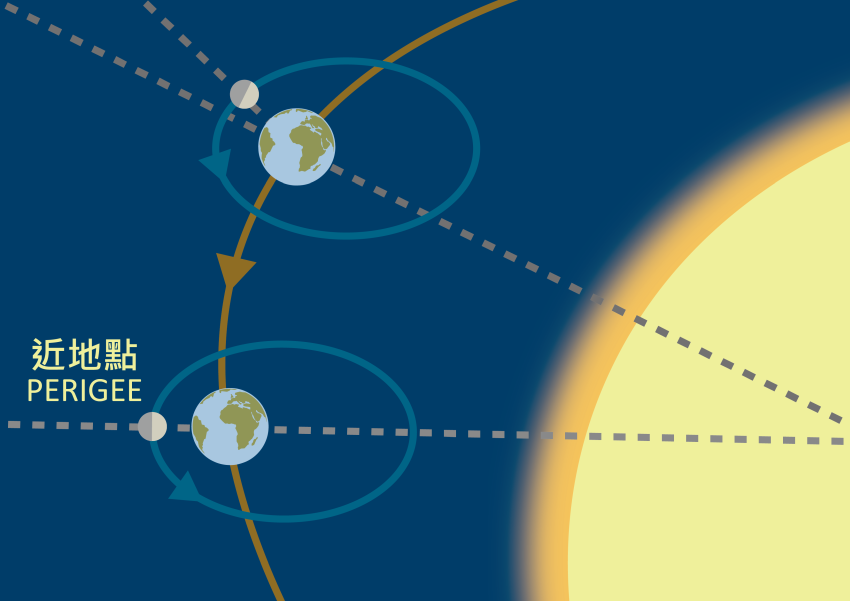
Figure 1. A schematic diagram showing how the Moon approaches its perigee position and becomes a full moon at the same time.
Aside from the full moon, a new moon can also coincide with the perigee. While we could not observe its larger apparent size, its effect on the tide is still evident by measuring the water level. The next such occurrence will be near 15 June 2026 (Figure 2). The high tide of the corresponding spring tide will occur on the next day at a height of 2.59 metres above Chart Datum (mCD) at Quarry Bay. Half a month later, the Moon will become a full moon around 30 June 2026 but will be near its apogee, the farthest point from the Earth. The high tide of the corresponding spring tide will only be at a height of 2.28 mCD. While tides are influenced by many factors, the difference between these heights gives us a rough idea of how much the perigee-apogee cycle can affect the tidal range.
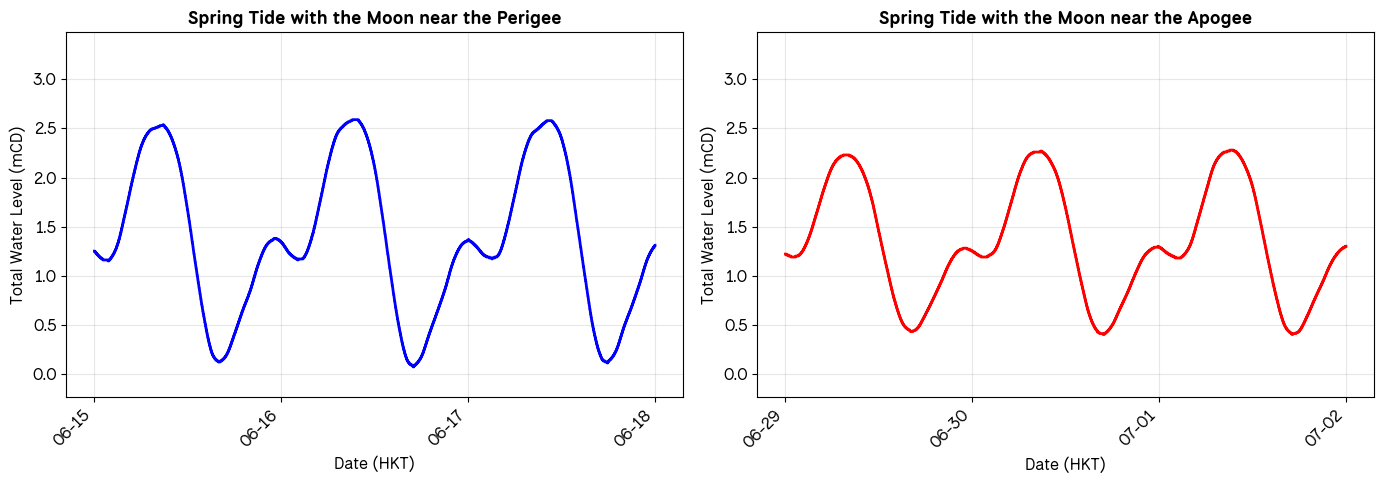
Figure 2. Spring tides at Quarry Bay around 15 June 2026 (left) and 30 June 2026 (right). In the former case, the Moon is also around its perigee. In the latter case, the Moon is near its apogee where high tides are not as high as the former and low tides are not as low as the former.
The complex interaction between various astronomical factors give rise to many different possibilities of spring tides, with some having a tidal range noticeably higher than the others (Figure 3). For a particular location on the Earth, when the Sun shines exactly above (when it casts no shadow), or when the Sun is exactly beneath our feet at the opposite side of the Earth, it means that the location also gets aligned with the Sun and the centre of the Earth. The ocean bulges along the alignment due to gravitational effects, and therefore that location will experience higher tides at those times. For Hong Kong, this occurs around midday near the Summer Solstice (in late June) and around midnight near the Winter Solstice (in late December). If such a time coincides with the high tide of a spring tide or even a perigean spring tide, the high tide will be even much higher.
The characteristics of spring tide that can be observed from the tidal range plots for Quarry Bay in Figure 3 are summarised as follows:
- The tidal range is generally higher around the time of a new moon (yellow line) or a full moon (blue line);
- The tidal range is even higher when a new moon (yellow line) or a full moon (blue line) is also close to a Moon’s perigee (purple dashed line), i.e. perigean spring tide;
- The highest high tides happen during those perigean spring tides around late June and late December in Hong Kong due to seasonal change of the Sun’s position.
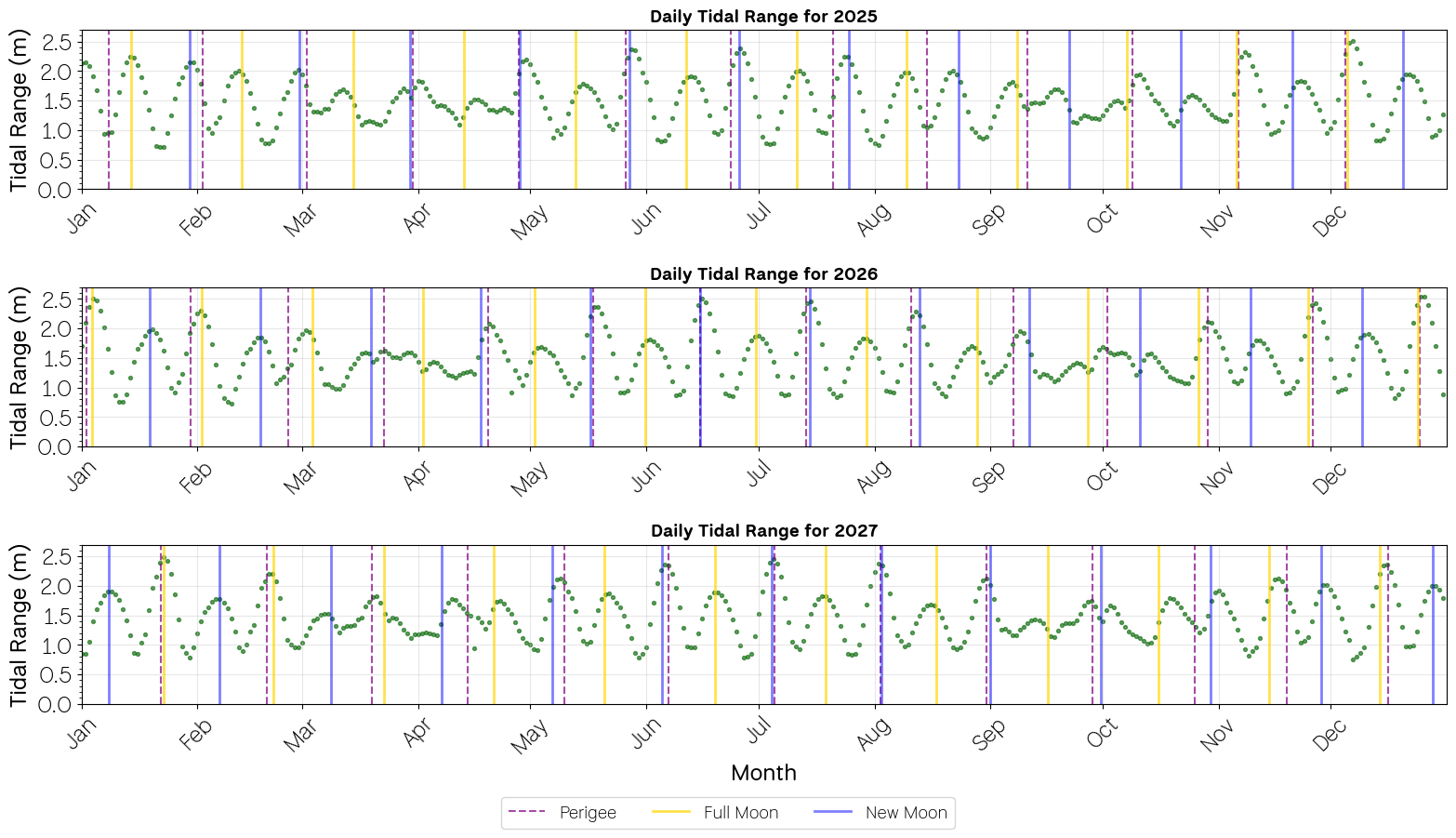
Figure 3. Daily tidal range (green dots) at Quarry Bay as calculated from astronomical tide predictions for 2025 to 2027. Generally, a higher tidal range indicates a higher high tide. Times of new moons (blue line), full moons (yellow line), and Moon’s perigees (purple dashed line) are marked on the graph.
Other astronomical factors also affect tidal ranges, but it is more difficult to be noticed. For example, whether the Earth is also at perihelion (its closest point to the Sun), whether the Moon is exactly above or beneath us, and other orbital details. The seawater will react to tidal force and flow accordingly, round the islands and over the bathymetry while deflecting due to the Earth’s rotation, so the resulting tidal effects will lag behind the astronomical events by a couple of days and the amplitude will be modulated. All these above-mentioned factors together shape the astronomical tide.
Meteorological factors also affect water level. For example, the Northeast Monsoon or a tropical cyclone may also raise the water level by pushing water towards the shore by strong winds. If any of such meteorological phenomena coincides with an amplified spring tide, the water level will become abnormally high (see Figure 4) and may cause flooding in low-lying coastal areas. As mentioned in the above, the higher astronomical high tides tend to occur overnight around late December in Hong Kong. Hence, when the Northeast Monsoon prevails in winter, there is a higher chance of flooding in low-lying coastal areas at night during spring tides. For example, the minor flooding event in early January 2026 (see Blog on High Water level due to Combined Effect of the Northeast Monsoon and Spring Tide) happened at night.
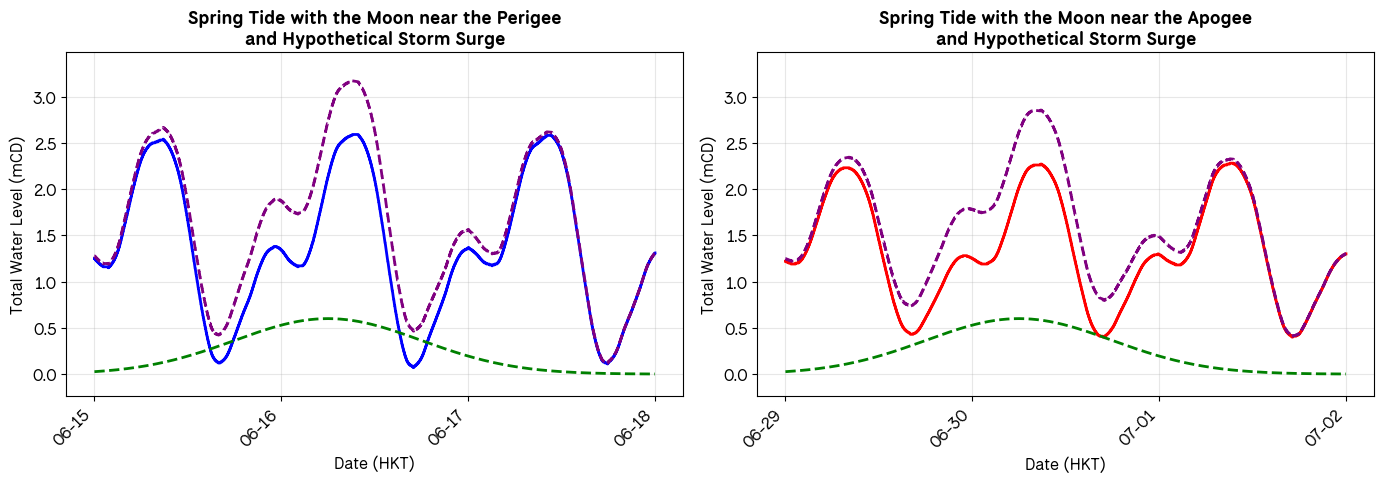
Figure 4. Similar to Figure 2, but with a hypothetical storm surge situation. The green dashed lines show the same storm surge. The purple dashed lines show the total sea level by adding storm surge to the astronomical tide. With the spring tide amplified by the Moon at its perigee position, the high tide becomes markedly higher (left).
Members of the public can refer to the “Coastal Sea Level” webpage or “MyObservatory” mobile app to obtain the total water level forecasts at different tide stations in Hong Kong for the next 12 hours, which incorporates astronomical tide prediction and the anomalies brought about by meteorological factor such as monsoons or storm surges. The information is useful for planning activities nearshore or taking advance precautionary measures against sea flooding in cases of high water level forecast.