Submission of Outdoor Radon Data to the Global Atmosphere Watch (GAW) by Hong Kong Observatory
30 April 2026
The Global Atmosphere Watch programme, established by the World Meteorological Organization, coordinates a global monitoring network to collect data, assess and provide early warnings on environmental impacts resulting from atmospheric changes. The Hong Kong Observatory has, since 2026, submitted periodically outdoor radon (Rn-222) activity concentration data collected at the King's Park Meteorological Station to the World Data Centre for Greenhouse Gases under the Global Atmosphere Watch programme after quality assurance and analysis. The data is used by international meteorological agencies and scholars for climate research and atmospheric analysis.
Radon is a naturally occurring radioactive gas primarily originating from the decay of uranium in soil and rocks. In atmospheric research, radon is regarded as an excellent "natural tracer" and an important diagnostic tool for interpreting greenhouse gas data. Since radon is released almost exclusively from land surfaces and has a short half-life (approximately 3.8 days), it acts as a "footprint" for air mass transport. If an air mass contains both greenhouse gases and radon, by analyzing the concentrations of both gases, we can identify the emission sources of these greenhouse gases. For example, if a monitoring station detects high concentrations of both greenhouse gases and radon simultaneously, scientists can conclude that the greenhouse gases likely originate from terrestrial emission sources. Conversely, if radon levels remain very low, it reflects that the air mass likely originates from a remote oceanic background. This assists in calibrating atmospheric transport models, thereby improving the accuracy of estimating the global distribution and sinks of greenhouse gases.
It is noteworthy that radon from the earth and cosmic rays from outer space are the two primary sources of the "natural background radiation" that humans are exposed to in daily life. While outdoor radon levels remain low due to atmospheric dilution, posing an extremely low risk to human health, continuous monitoring of its concentration trends remains important for deepening the scientific understanding of geological variations, the impact of climate change on the atmosphere, and environmental radiation monitoring.
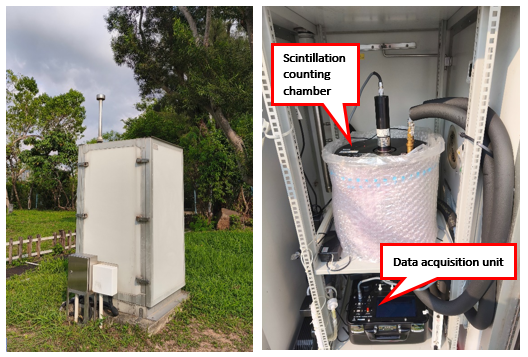
Equipment installed at King’s Park for monitoring outdoor Radon activity concentration